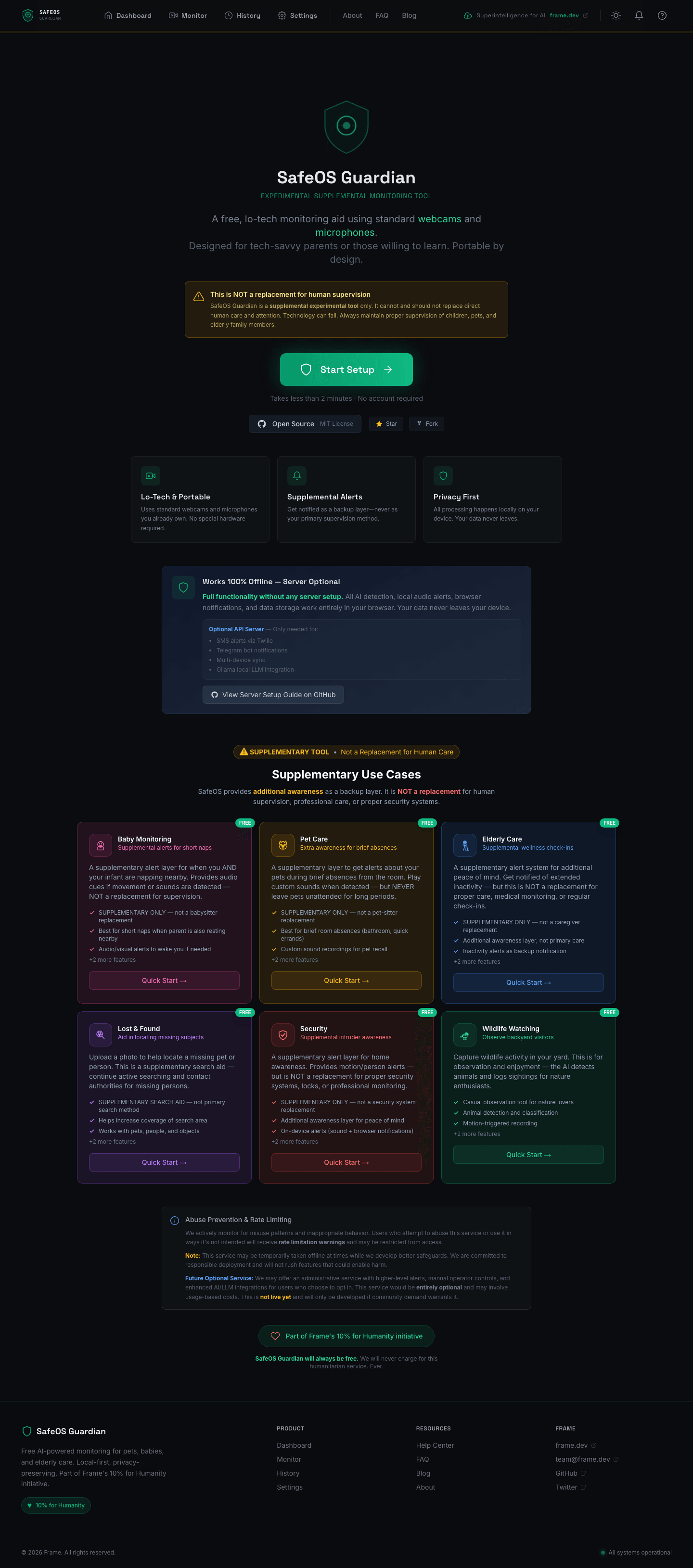
SafeOS Guardian is a free, MIT-licensed monitoring system for pets, babies, and elderly care. The detection pipeline runs in the browser via TensorFlow.js. If a local Ollama server is available, frames escalate to it. Cloud APIs are used only as a last-resort fallback, and only if the user has explicitly opted in. Source: github.com/framersai/safeos. Part of Frame's 10% for Humanity initiative.
What it does
Open safeos.sh, grant camera and microphone permission, and the page becomes a monitor — baby, pet, fall detector, or a lost-and-found scanner that watches for a specific subject by visual fingerprint. Inference runs in the browser via TensorFlow.js. When the local model crosses a concern threshold, the frame escalates: first to a local Ollama vision model on the LAN, then to a cloud LLM only if the user has enabled it. Alerts ramp from quiet to loud over a 120-second window until acknowledged. Everything is in a single open-source repo.
Three-tier escalation
Frames route through the cheapest possible tier first; the system only escalates when the cheap tier is uncertain. Most frames are boring (empty room, sleeping subject, no motion), so cloud spend stays effectively zero for the default case.

Tier 1 — Browser. Every frame runs through TensorFlow.js COCO-SSD (~45MB, cached) for object detection and Transformers.js ViT-base-patch16-224 (~89MB) for scene classification. Motion runs as a pixel-diff with user-defined detection zones. Audio runs through the Web Audio API's AnalyserNode with a frequency-band analyzer tuned for cries (300–600Hz, fundamental ~450Hz), pet sounds, or impact transients. No network calls after first load.
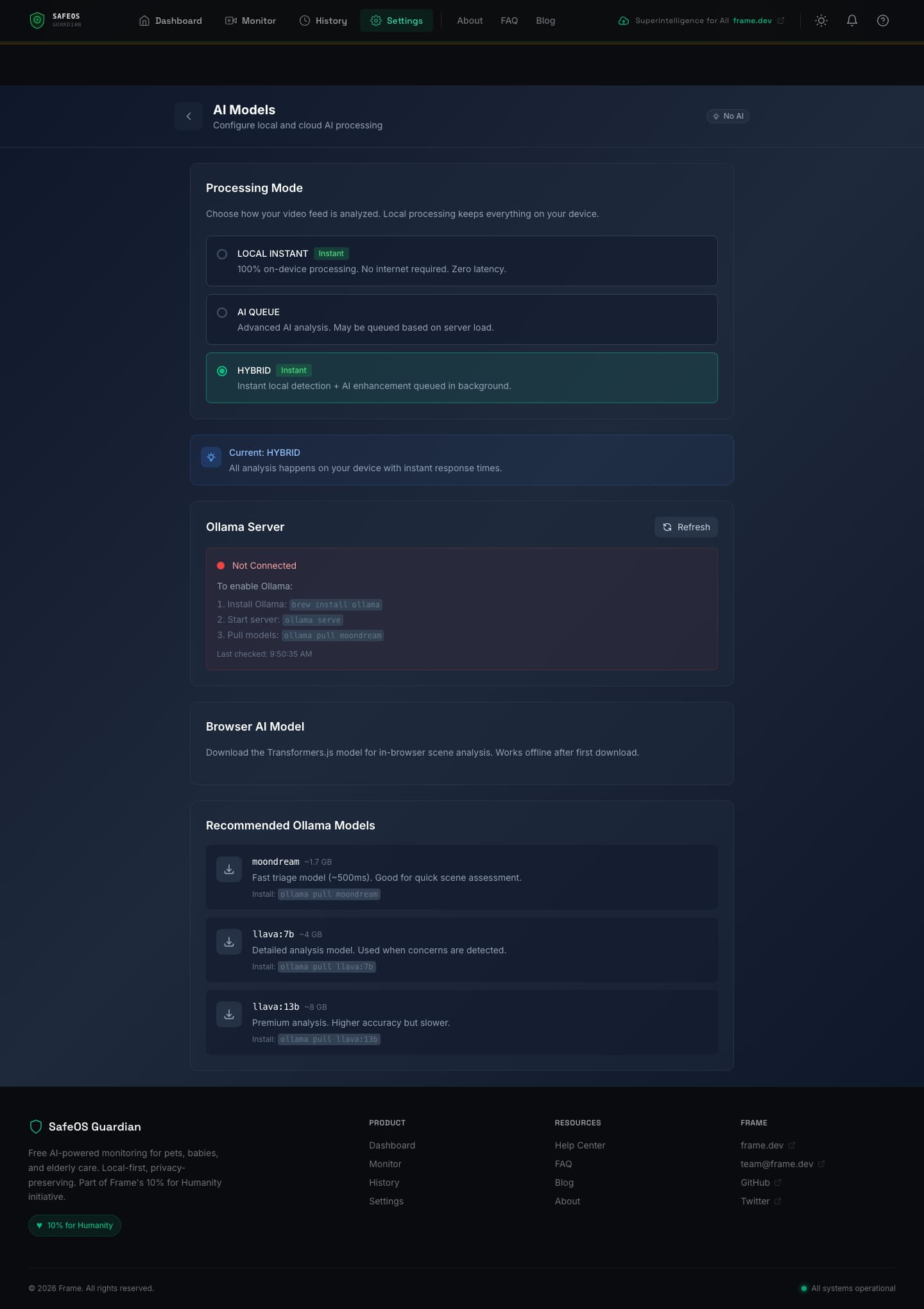
Tier 2 — Local Ollama (optional). If a Tier 1 signal crosses a concern threshold, the frame forwards to a local Ollama server running moondream (~1.7GB) for triage. If triage flags something worth a closer look, llava:7b (~4GB) runs scenario-specific analysis with a prompt selected from baby, pet, elderly, or security mode. For complex reasoning, llama3.2-vision:11b (~8GB) is supported.
Tier 3 — Cloud fallback (opt-in). Used only for ambiguous cases that Tier 2 cannot resolve, and only if cloud fallback has been enabled. Three providers wire through a single client in cloud-fallback.ts: google/gemini-flash-1.5 via OpenRouter, gpt-4o-mini via OpenAI, and claude-3-haiku-20240307 via Anthropic. Frames are redacted before transit and rate-limited.
Detection pipeline
Motion with zones
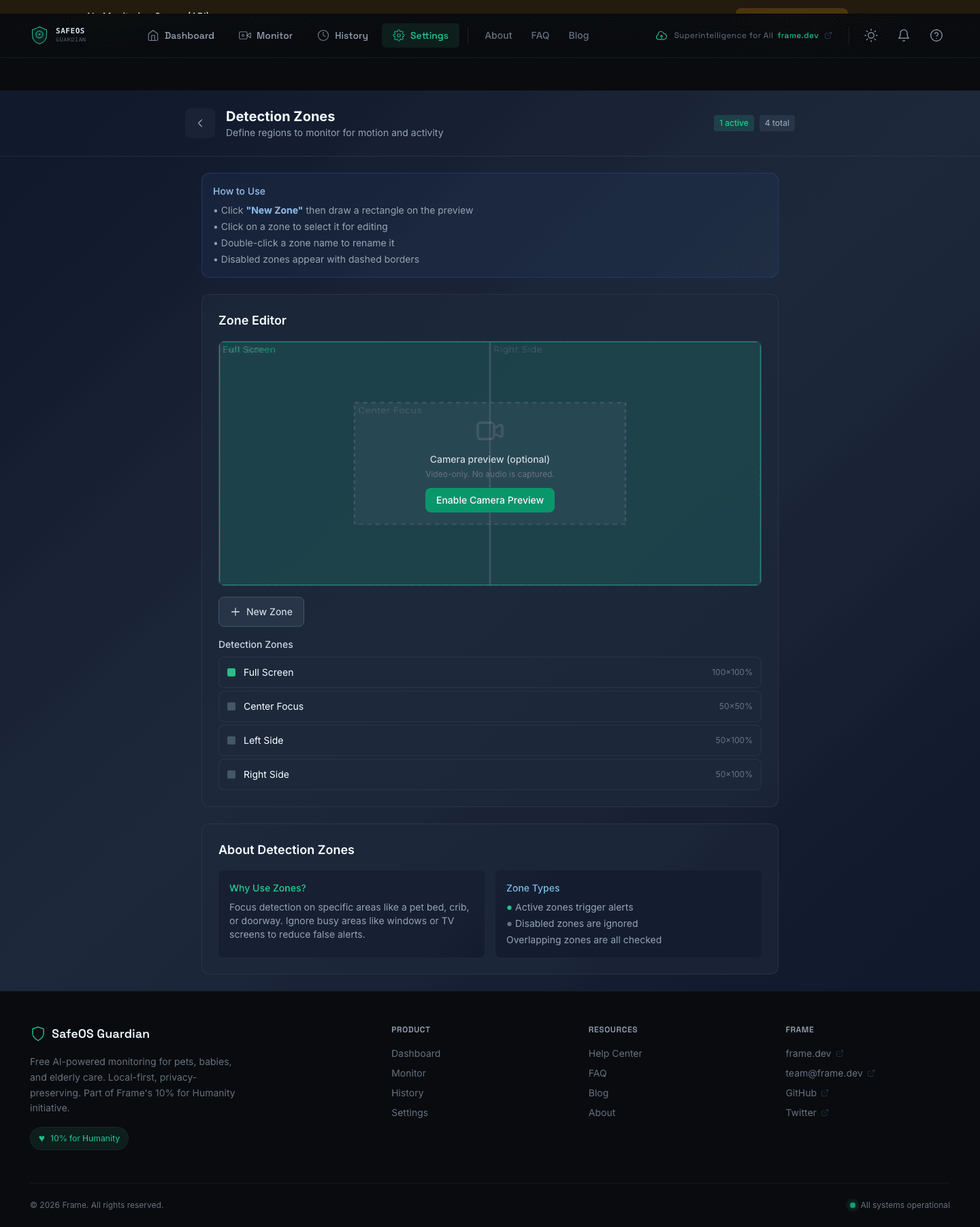
The frame analyzer computes a pixel delta between the current frame and a calibrated baseline. A user-defined detection zone system masks out busy areas (TVs, windows with moving leaves, ceiling fans) and focuses detection on specific regions like a crib, pet bed, or doorway. Zones are stored as normalized rectangles, can overlap, and are independently checked.
Audio
The audio pipeline does FFT in real time via the Web Audio API. Cry detection isolates the 300–600Hz band where infant cries concentrate (around a 450Hz fundamental). Pet sounds use broader spectral patterns. Elderly fall detection listens for short impact transients. A rolling noise floor reduces false positives in noisy rooms.
Vision
Two models run in sequence. COCO-SSD handles fast object detection — person, dog, cat, chair, couch. If the scenario needs scene-level understanding ("is the baby still in the crib, or did they climb out?"), Transformers.js ViT runs classification. Both models pull from their CDNs once and cache in the service worker for offline use.
Lost & Found
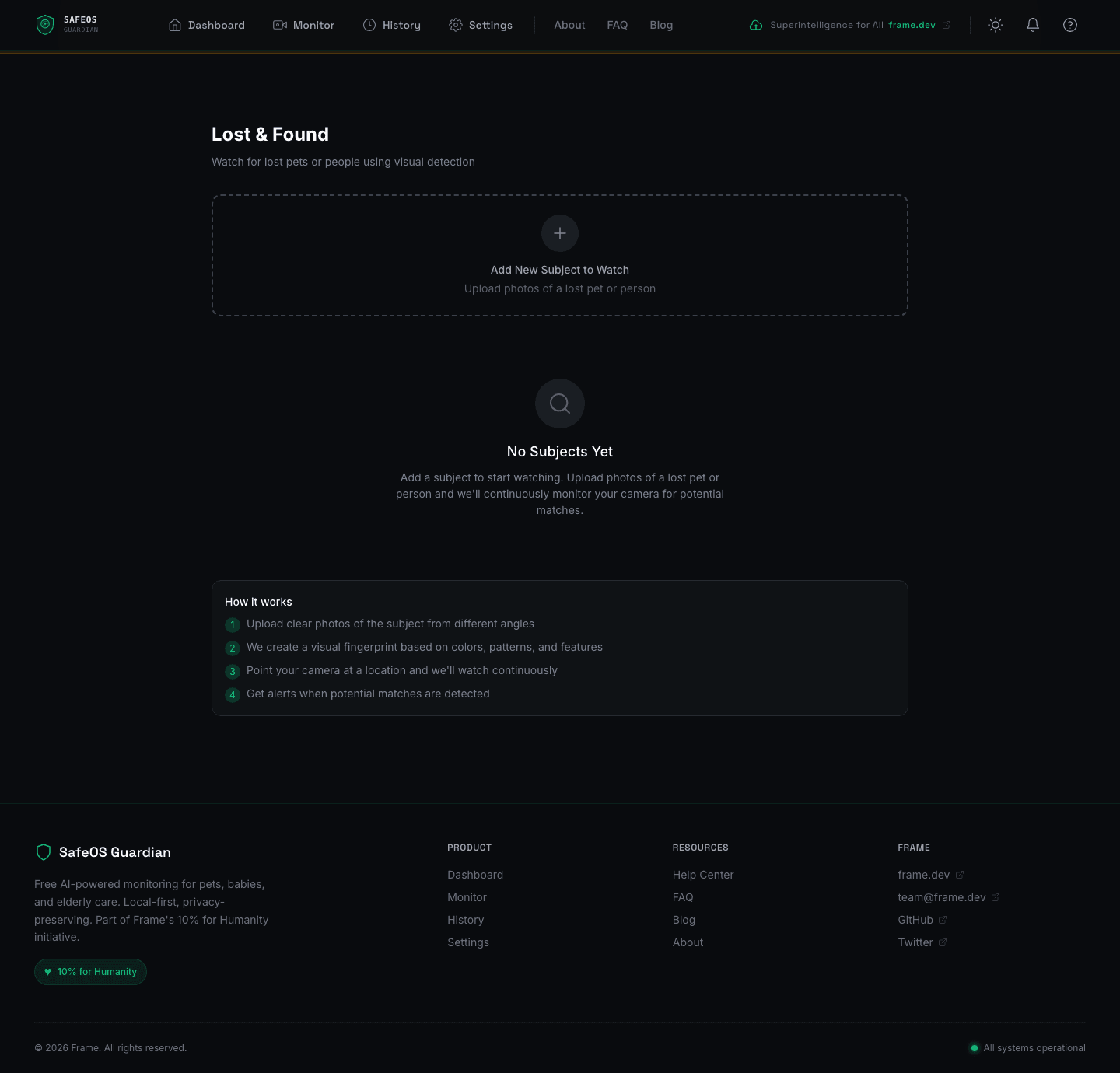
The user uploads photos of a missing pet or person. The system extracts a visual fingerprint — color histogram, dominant colors, edge signatures, size ratios. The camera then continuously watches for matches. On a hit, the user gets an alert with the matched frame.
It's not face recognition. It's a lightweight visual matcher that works for pets (where face ID is unreliable) as well as people. Limitation: works well for visually distinct subjects, less well for uniform ones.
Alert pipeline
SafeOS uses a four-level severity system — info, warning, critical, emergency — with a volume ramp from quiet to loud over a 120-second window until acknowledged.

Each severity has its own cooldown to prevent alert fatigue. Emergency alerts have zero cooldown and immediately escalate. Info alerts have a multi-second minimum gap. A content-filter service checks messages against safety policies before dispatching, and quiet-hours config lets you suppress non-critical alerts during configured windows.
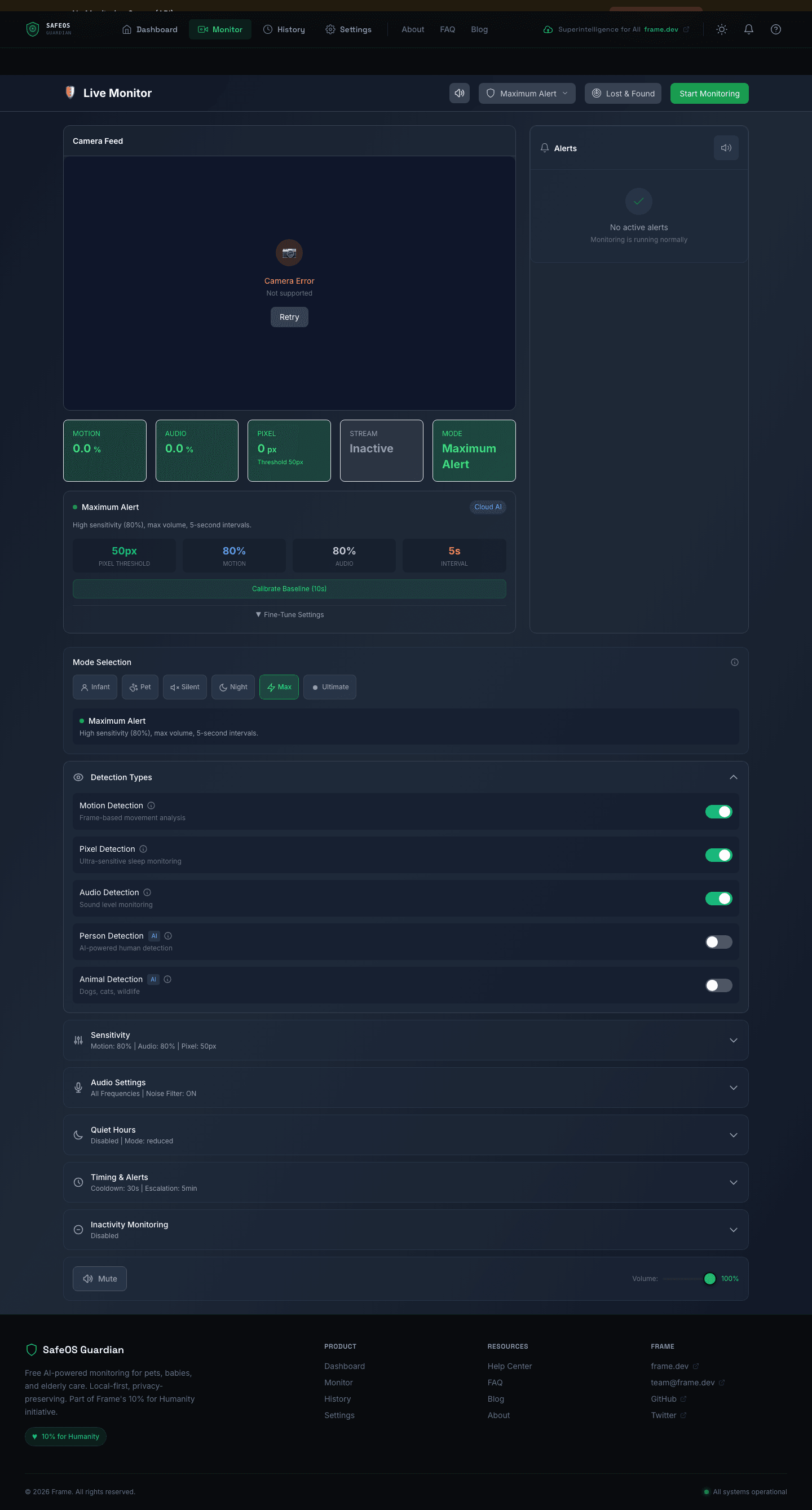
The Monitor view surfaces this live — motion percentage, audio levels, pixel deltas, stream state, sensitivity sliders, detection toggles, audio frequency profiles, per-severity cooldown controls, inactivity monitoring, volume overrides — all in a single admin dashboard.
Backend
The optional Express backend is ~12,400 lines of TypeScript across 45 files. Clean domain boundary: API routes handle transport, library services handle logic, queues handle background work. It uses @framers/sql-storage-adapter (the same SQLite layer used by AgentOS) for persistence, BullMQ for frame analysis and human review jobs, and Socket.io for real-time WebSocket delivery.
src/
├── api/
│   ├── server.ts           — Express + WebSocket bootstrap
│   ├── routes/             — 13 route files, ~36 handler invocations
│   │   ├── auth.ts         — session + email auth (519 lines)
│   │   ├── export.ts       — GDPR data export (483 lines)
│   │   ├── webhooks.ts     — third-party integrations (383 lines)
│   │   ├── email-auth.ts   — passwordless email flow (403 lines)
│   │   ├── streams.ts      — monitoring stream CRUD (278 lines)
│   │   ├── profiles.ts     — scenario profiles (251 lines)
│   │   ├── alerts.ts       — alert management (239 lines)
│   │   ├── analytics.ts    — usage analytics (235 lines)
│   │   ├── review.ts       — human review queue (221 lines)
│   │   ├── system.ts       — health + status (184 lines)
│   │   ├── analysis.ts     — analysis results (169 lines)
│   │   └── notifications.ts — push/telegram registration (152 lines)
│   ├── middleware/         — auth, rate-limit, Zod validation
│   └── schemas/            — API validation schemas
├── lib/
│   ├── analysis/
│   │   ├── frame-analyzer.ts   — two-tier vision pipeline
│   │   ├── cloud-fallback.ts   — multi-provider LLM routing
│   │   └── profiles/           — baby, pet, elderly, security prompts
│   ├── alerts/
│   │   ├── escalation.ts       — volume ramping 0→100%
│   │   ├── notification-manager.ts
│   │   ├── browser-push.ts     — Web Push VAPID
│   │   ├── twilio.ts           — SMS
│   │   └── telegram.ts         — Telegram Bot
│   ├── audio/analyzer.ts       — cry / distress detection
│   ├── ollama/client.ts        — moondream / llava integration
│   ├── safety/                 — content filter, disclaimers
│   ├── streams/manager.ts      — stream lifecycle
│   ├── review/human-review.ts  — review queue workflow
│   └── webrtc/signaling.ts     — WebRTC signaling
├── queues/
│   ├── analysis-queue.ts       — BullMQ frame analysis
│   └── review-queue.ts         — human review jobs
└── auth/email-auth.ts
Every frame is written to a rolling 5–10 minute buffer and then discarded. Nothing is stored long-term unless you explicitly export it. The GDPR export endpoint builds a complete user data package on demand, can compress it, mark frames as exported for incremental sync, and hand back a signed bundle.
Settings
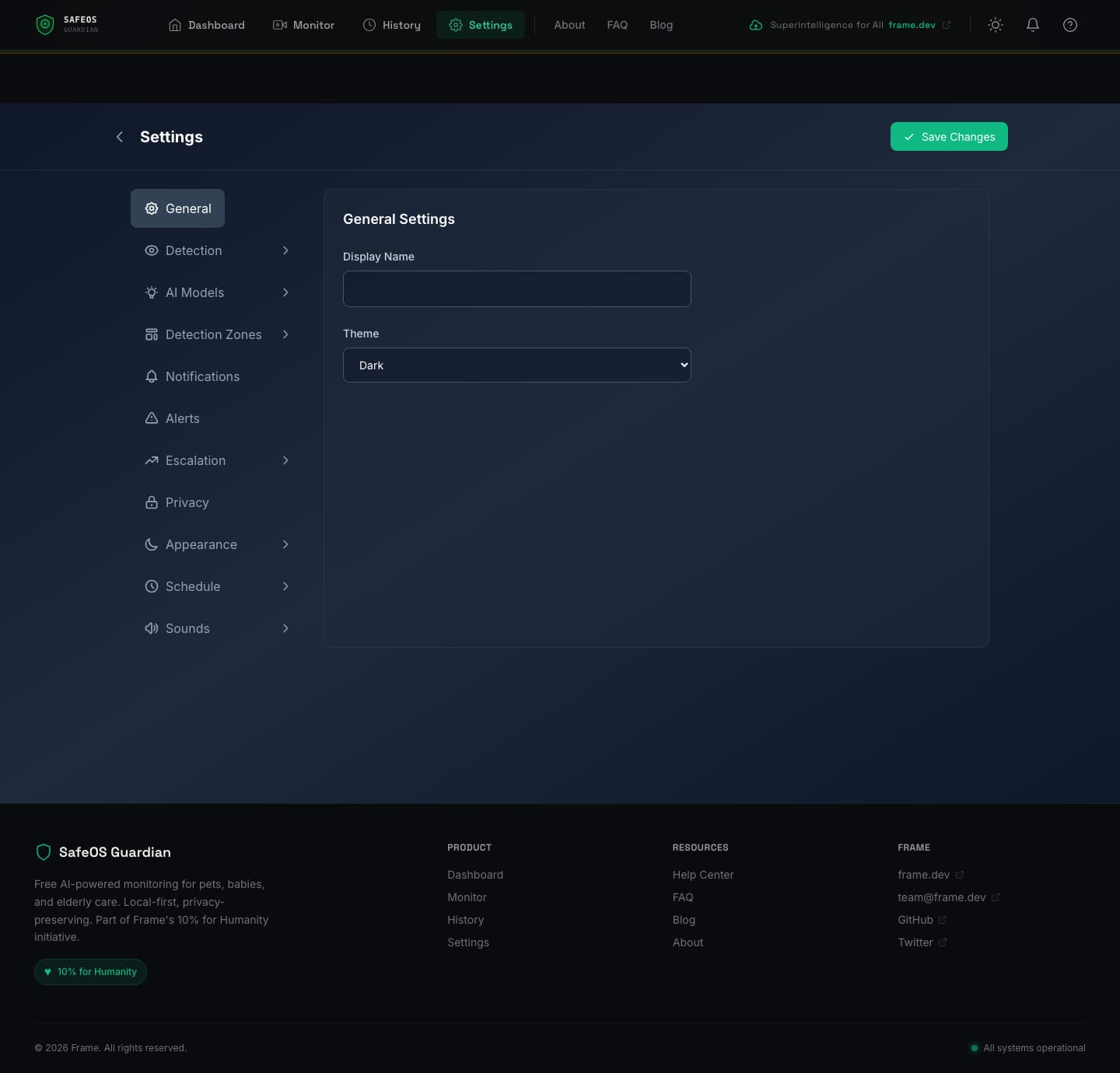
The settings surface is broad — every detection rule, model choice, threshold, and notification channel is independently configurable. General settings, detection tuning, AI model selection, detection zones, notification channels, alert thresholds, escalation timing, privacy controls, appearance, schedule, sounds — all separate pages, all version-controlled in the open repo.
Local timeline and export
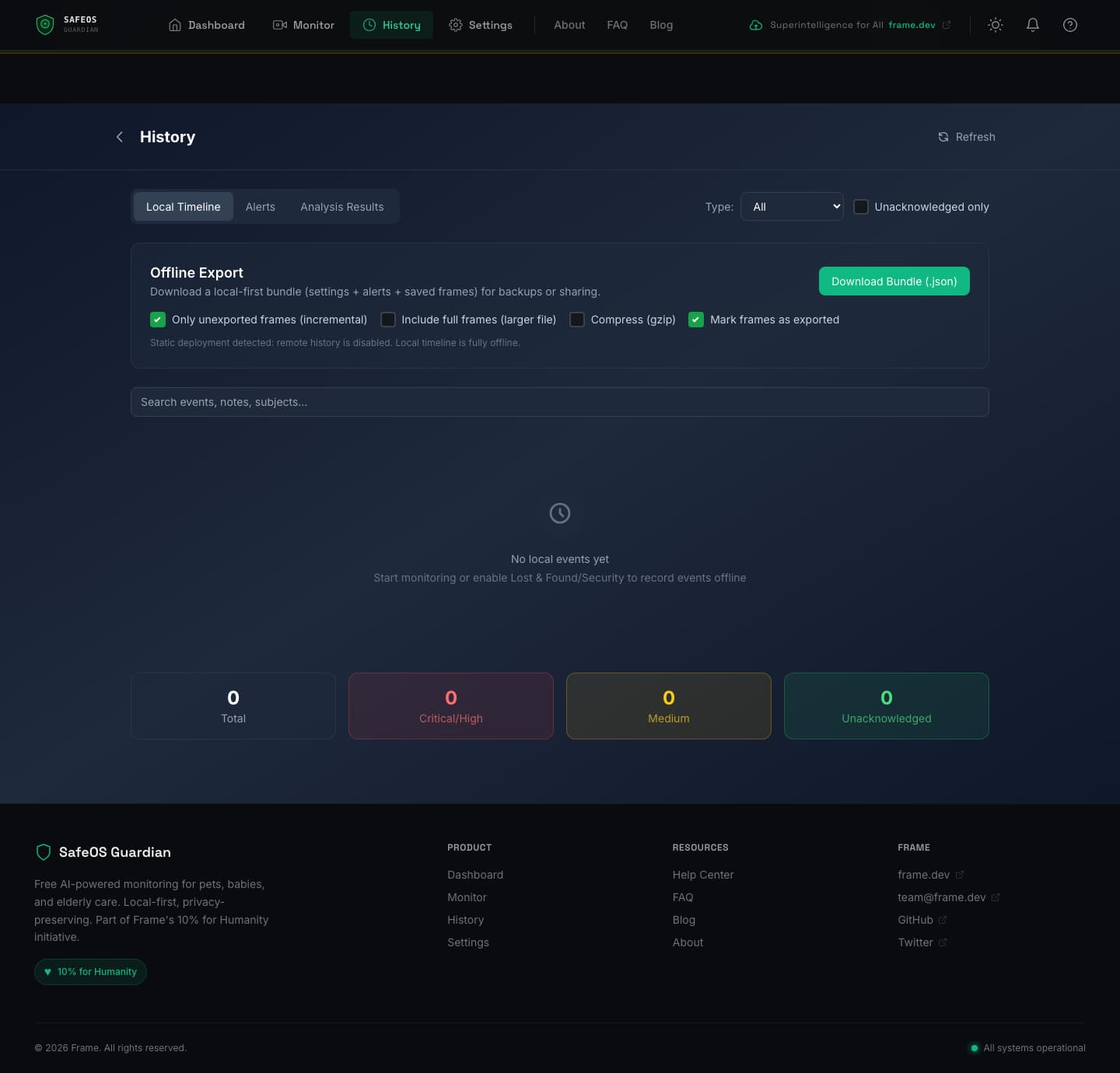
History is stored in IndexedDB for offline-first mode. Events are timestamped, filterable by type (alerts, lost & found, intrusions), and searchable. A local bundle export downloads your complete history as JSON — optionally with full frames embedded, gzip compressed — for backups, sharing with a family member, or transferring to another device. Exported frames can be marked so subsequent exports only include new ones (incremental sync).
Privacy
Frames never leave the device unless the user has explicitly opted in, and even then only with the minimum necessary data:
- Local-first. Tier 1 inference runs entirely in the browser. Zero network calls.
- Rolling buffer. Only 5–10 minutes of frames are ever in memory. Old frames discarded.
- No cloud storage. Frames are analyzed and dropped. Only user-initiated exports persist.
- Anonymization. Frames forwarded to human review (if enabled) get faces and sensitive areas blurred.
- Rate limiting. Cloud fallback is rate-limited aggressively to prevent runaway spend and abuse.
- GDPR export. One-click full data export and deletion.
- Abuse prevention. The service monitors for misuse patterns and can restrict access. Documented openly.
Limitations
- Tier 2 escalation requires a user-managed Ollama install. Without it, the system runs Tier 1 + Tier 3 only.
- The four-level severity system uses a single threshold profile. Per-scenario tuning is not yet implemented.
- Lost-and-found visual fingerprinting performs well on visually distinct subjects, less well on uniform ones.
- Capacitor iOS/Android shells exist but are not yet published to either app store. The PWA install path is the supported mobile experience.
- GDPR export format has no v2 migration path yet.
Tech stack
| Layer | Stack |
|---|---|
| Frontend | Next.js 14, React 18, TypeScript 5.3, Tailwind CSS 3.3, Zustand 4.4, next-intl 4.6 |
| Client ML | TensorFlow.js 4.17, COCO-SSD, Transformers.js (Xenova) 2.17, ViT-base-patch16-224 |
| Client storage | IndexedDB via idb 7.1, service worker cache |
| Mobile | Capacitor 5.6 (iOS / Android shells, not yet shipped to stores) |
| Backend | Express 4.21, Socket.io 4.8, BullMQ 5.31, better-sqlite3, @framers/sql-storage-adapter 0.4 |
| Backend AI | Ollama 0.5, OpenAI 4.72, Anthropic SDK 0.32, sharp 0.33 |
| Notifications | Twilio 5.3, node-telegram-bot-api 0.66, web-push 3.6 (VAPID) |
| Realtime | WebRTC via simple-peer 9.11 |
| Testing | Vitest 2.1 (41 test files), Playwright E2E 1.40 |
| Validation | Zod 3.23 schemas |
| DevOps | Docker 7-stage multi-stage build, pnpm monorepo, Caddy reverse proxy |
The monorepo is around 100 .tsx components in the Next.js frontend (~70k LOC), 45 backend TypeScript files (~12k LOC), 41 test files between Vitest and Playwright, and ten markdown docs anchored by a 462-line ARCHITECTURE.md that walks through every layer.
Links
Website: safeos.sh
GitHub: github.com/framersai/safeos
Frame.dev: frame.dev